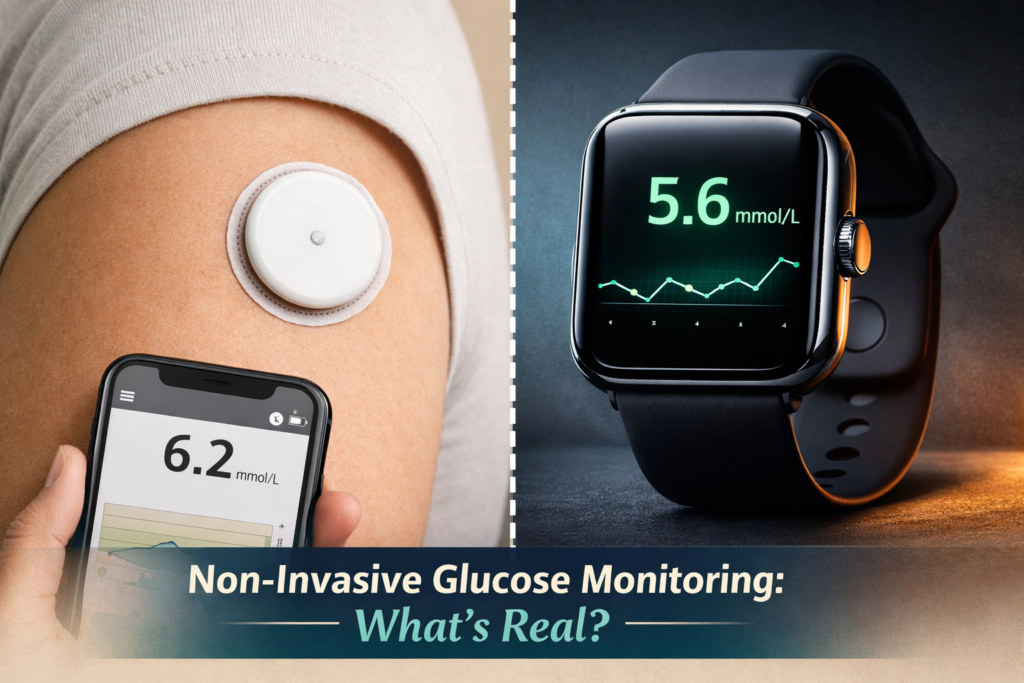
There’s a little wish I think most of us living with diabetes carry around quietly.
What if checking our blood sugar didn’t involve poking, inserting, replacing, or attaching anything at all?
No sensor change days.
No filament under the skin.
No “is this one going to sting?” moment.
I’ve definitely wished for that.
So when I recently received an article from Diabetes Canada warning about unauthorized blood glucose monitors being sold online — especially ones claiming to be non-invasive — it caught my attention immediately.
Because that’s exactly the dream they’re selling.
And I get the temptation.
The Reality We Need to Sit With
There is real research happening in non-invasive glucose monitoring. Brilliant scientists and tech companies are working on it. It’s not science fiction.
But here’s the grounded truth:
As of right now, no truly non-invasive glucose monitor has been approved by major medical regulators for managing diabetes. Not in Canada. Not elsewhere.
That’s not pessimism. That’s just where the science currently stands.
And when there’s a gap between what we hope for and what actually exists? That’s where the internet gets creative.
An Official Warning From Health Canada
After reading the piece from Diabetes Canada, I looked further and found a public advisory issued by Health Canada.
In that warning, Health Canada states that unauthorized blood glucose monitors — including those marketed as non-invasive — are being sold online and may pose serious health risks.
These devices:
- Have not been assessed for safety or effectiveness
- May provide inaccurate glucose readings
- May fail to alert users to dangerous highs or lows
And here’s the key point:
No non-invasive blood glucose monitoring devices are currently authorized for sale in Canada.
If you’d like to read the full advisory, you can find it here:
👉 https://recalls-rappels.canada.ca/en/alert-recall/unauthorized-blood-glucose-monitors-sold-online-may-pose-serious-health-risks
This isn’t internet gossip. It’s an official government safety alert.
Why This Actually Matters
Managing diabetes — whether you’re on insulin or managing through lifestyle and medication — comes down to numbers.
We make decisions based on those numbers.
If a device gives you a falsely low reading, you might treat a low that isn’t there.
If it gives you a falsely normal reading, you might miss a high that needs attention.
Inaccurate glucose data isn’t just inconvenient.
It can be dangerous.
And no sleek watch or ring is worth gambling your safety over.
Red Flags to Watch For
If you see ads for devices that:
- Claim “no needles, no sensors, medical-grade accuracy”
- Are sold primarily through social media ads
- Don’t clearly state regulatory approval
- Promise unlimited readings with a one-time purchase
- Measure glucose, blood pressure, cholesterol, and everything else all from your wrist
Pause.
Right now, legitimate continuous glucose monitors still require a tiny filament under the skin to measure interstitial glucose. They are minimally invasive — and clinically validated.
If something sounds too good to be true in diabetes tech, it usually is.
The Better, Not Perfect Takeaway
I want non-invasive glucose monitoring to become real. Truly. It would be incredible.
But until that day comes, I’m choosing reliable over flashy.
Because managing diabetes isn’t about chasing miracles.
It’s about steady, informed decisions.
It’s about protecting our health.
It’s about better — not perfect.
And that starts with numbers we can trust.