I didn’t always take chia seeds seriously.
They felt like one of those “health trends” that shows up overnight—somewhere between kale chips and whatever smoothie was popular that year. Tiny, almost invisible… easy to overlook.
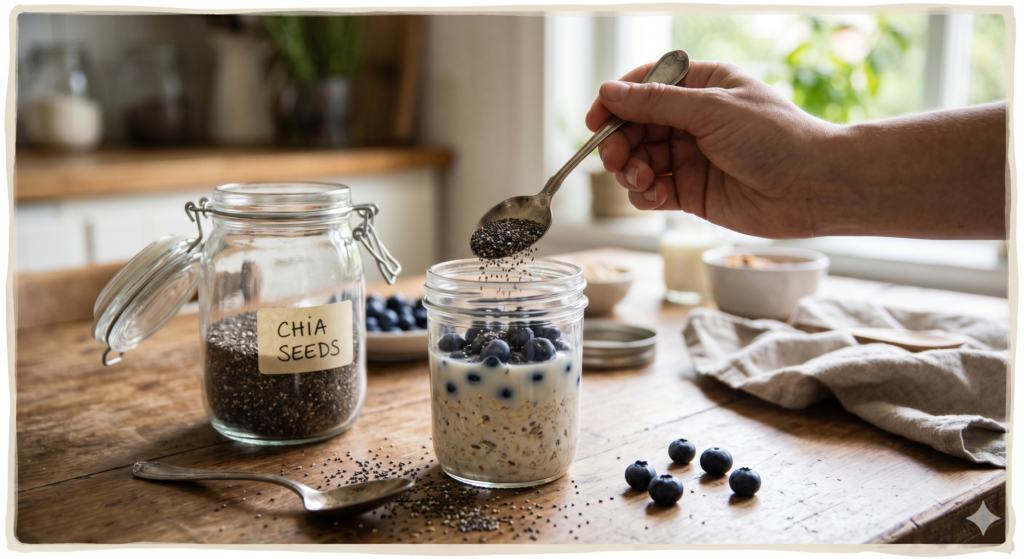
The first time I added them to anything, it was more out of curiosity than intention. A spoonful into overnight oats, just to see what the fuss was about.
By morning, they had completely changed the texture—thicker, almost pudding-like. Subtle, but different.
And that’s kind of how chia seeds work.
Quietly.
What I didn’t realize at the time is that those tiny seeds are doing more than just sitting there. They’re loaded with fiber—about 5 grams in a single tablespoon—along with a bit of protein and healthy fats.
All things that tend to slow digestion down.
Including how quickly sugar enters the bloodstream.
Not in a dramatic, overnight way—but enough to notice over time.
Now they’ve just become part of my rhythm.
A spoonful in overnight oats.
Mixed into cottage cheese or yogurt with blueberries when I need something quick.
Sprinkled over cereal.
Even tossed onto a salad when I remember.
Nothing complicated. Nothing precise.
Just… added in.
From what I’ve learned along the way, chia seeds have a very low glycemic impact. On their own, they barely move the needle—both in glycemic index and glycemic load, especially in the small amounts most of us use.
But what’s more interesting is how they can shift the overall load of a meal, helping to soften the rise instead of trying to prevent it completely.
And that distinction matters.
Because managing blood sugar isn’t always about removing foods.
Sometimes it’s about building around them.
It’s funny—chia seeds go back centuries, used by ancient civilizations like the Aztecs for energy and endurance. And here we are, still finding small ways they fit into modern routines.
Not as a miracle.
Just as support.
These days, I don’t think of them as a “superfood.”
Just a small addition that tends to make things feel a little more balanced.
And sometimes, that’s enough.
It doesn’t have to be a big shift—
just something you’ll actually keep doing.