There is something about a family gathering and food.
Maybe it is the smell coming from the kitchen. Maybe it is seeing a table filled with dishes that only seem to appear at certain times of the year. Maybe it is the person who says, “Come on, have another helping!” before you’ve even finished the first one.
And then there is Thanksgiving.
In just over a week, many Canadians like myself will be sitting down with family and friends to celebrate Canadian Thanksgiving. There will be turkey, stuffing, potatoes, gravy, vegetables, dinner rolls, cranberry sauce, and probably enough dessert to feed a small army.
And if you live with Type 2 diabetes, you might also have that little voice in the back of your head saying:
“Okay… how am I supposed to get through this?”
The answer isn’t to avoid Thanksgiving.
It isn’t to bring your own separate meal.
And it certainly isn’t to spend the entire day worrying about every bite.
The goal is to enjoy the gathering while making a few measured choices that can help keep your blood glucose from taking a holiday of its own.
The Family Table Is Not a Nutrition Spreadsheet
One of the hardest things about eating with family isn’t necessarily the food.
It’s everything surrounding the food.
There are traditions.
There are expectations.
There are family recipes that have been passed down for years.
There is Aunt Somebody insisting you try her famous casserole.
There is someone who has already decided that you need another helping.
And there is usually dessert sitting somewhere within eyesight.
Food is part of how we celebrate. It connects us to memories, people and places.
So when you’re managing Type 2 diabetes, I don’t think the answer is to remove yourself from that experience.
Instead, I think it is about learning how to participate differently.
Start With the Plate
Thanksgiving dinner doesn’t have to become a battle between everything you want to eat and everything you think you shouldn’t eat.
Look at the whole plate.
Can you start with vegetables or salad?
Can you choose a reasonable portion of turkey or another lean protein?
Can you enjoy the potatoes or stuffing without piling both halfway to the ceiling?
Can you have some gravy without turning the plate into a swimming pool?
It sounds simple.
Because it is.
The trick isn’t necessarily eliminating the foods you love.
It’s how much you put on the plate and what you put beside it.
A balanced plate can give you room for the foods that make Thanksgiving feel like Thanksgiving.
You Don’t Have to Say No to Everything
This is probably one of the biggest lessons I’ve learned since being diagnosed with Type 2 diabetes.
There is a difference between saying:
“I can’t have that.”
and
“I’m going to have some of that.”
Those two statements can lead to very different relationships with food.
If pumpkin pie is part of your Thanksgiving tradition, perhaps you have a smaller slice.
If stuffing is your favourite part of the meal, enjoy some.
If mashed potatoes are what makes the dinner feel complete, put some on your plate.
The measured part isn’t necessarily what you eat.
Sometimes it’s simply how much.
And sometimes that little shift is enough to let you enjoy the occasion without feeling like diabetes has taken your seat at the table.
Watch the Carbohydrate Pile-Up
Here’s where Thanksgiving can get sneaky.
It isn’t always one particular food.
It’s the combination.
Potatoes.
Stuffing.
Dinner rolls.
Cranberry sauce.
Dessert.
Maybe an appetizer before dinner.
And perhaps leftovers later that evening.
Individually, these foods may seem manageable.
Together, they can create quite a carbohydrate load.
That’s why I like to think about the carbohydrate pile-up.
You don’t necessarily have to eliminate the potatoes.
You might simply skip the roll.
You don’t have to skip dessert.
You might have a smaller portion of stuffing.
It’s about making choices rather than letting the entire meal happen to you.
Eat Slowly
This might be one of the simplest Thanksgiving strategies of all.
Slow down.
Family gatherings are social events, but sometimes we eat as though someone is about to take the plate away.
Take a bite.
Put the fork down.
Talk.
Laugh.
Enjoy the conversation.
Give yourself some time before deciding whether you really want seconds.
Your brain and your stomach don’t always communicate at the speed of a Thanksgiving dinner.
Sometimes the best thing you can do is give them a chance to catch up.
And About Seconds…
Here’s a little family-gathering reality check:
You don’t have to accept seconds just because someone offers them.
“I’m good, thanks” is a perfectly acceptable answer.
So is:
“That was delicious, but I’m going to wait a bit.”
And if, after some time, you’re genuinely hungry and want another small helping?
That’s okay too.
The goal isn’t perfection.
The goal is being intentional.
Don’t Forget the After-Dinner Walk
Here’s something that doesn’t require a special recipe, a food scale or a complicated strategy.
Take a walk.
After dinner, instead of immediately settling into the couch for the annual post-meal food coma, invite someone to come with you.
Walk around the neighbourhood.
Take the dog.
Walk with your spouse.
Get the kids moving.
Or simply take a few minutes for yourself.
It doesn’t have to be a marathon.
You’re just giving your body an opportunity to move after a larger meal.
And there’s another bonus:
You get to escape the dessert table for a few minutes.
That’s what I call a win-win.
What About Checking Your Blood Glucose?
If you monitor your blood glucose, Thanksgiving can actually be an interesting opportunity to learn.
Not to judge yourself.
Not to see whether you were “good” or “bad.”
Just to observe.
If you normally check your blood glucose around meals, follow your usual routine.
You may discover that a particular combination of foods affects you differently than you expected.
Maybe the potatoes weren’t the biggest factor.
Maybe the stuffing and dessert together made a bigger difference.
Maybe your portion size mattered more than the specific food.
Your numbers can provide information.
They don’t provide a grade.
One higher reading doesn’t mean you failed Thanksgiving.
And one good reading doesn’t mean you have discovered a magical Thanksgiving formula.
It is simply another piece of information about your own body.
Family Pressure Can Be Harder Than Food
Sometimes the hardest part of eating at a family gathering isn’t what is on the table.
It’s what people say.
“You can have one.”
“It’s Thanksgiving!”
“Come on, live a little.”
“You’re allowed to cheat today.”
I’ve heard variations of these kinds of comments many times.
But here’s the thing:
You don’t need to justify your choices.
You don’t need to explain your blood glucose.
You don’t need to give everyone a medical lecture between the turkey and the pie.
A simple:
“I’m going to have some, but I’m watching my portions.”
is enough.
Your health doesn’t need a committee meeting.
And If You Overdo It?
Let’s be honest.
It might happen.
You might eat more stuffing than you planned.
You might have the bigger piece of pie.
You might go back for seconds.
You might look down at your plate afterward and think:
“Well… that escalated quickly.”
Welcome to being human.
Don’t turn one meal into a week-long guilt trip.
Don’t decide you’ve ruined everything.
Don’t skip the next meal to compensate.
Don’t punish yourself with excessive exercise.
Just get back to your normal routine.
Drink some water.
Move when you can.
Make your next meal your normal balanced meal.
And carry on.
Thanksgiving is one meal.
It isn’t a referendum on your diabetes management.
The Measured Thanksgiving
For me, this is what being “measured” really means.
It doesn’t mean being perfect.
It doesn’t mean refusing every food that contains carbohydrates.
It doesn’t mean sitting at the Thanksgiving table watching everyone else eat while I nibble on something I don’t even want.
It means being present.
It means enjoying the food.
It means paying attention to portions.
It means choosing what matters most to me.
It means slowing down.
It means moving afterward.
And it means remembering that one celebration doesn’t define my overall health.
Because there will always be another meal.
Another family gathering.
Another birthday.
Another restaurant dinner.
Another piece of pie.
And another opportunity to make a choice.
This Thanksgiving, Enjoy the Table
If you’re living with Type 2 diabetes, you don’t have to choose between taking care of yourself and enjoying Thanksgiving.
You can do both.
Fill your plate thoughtfully.
Choose the foods you really want.
Eat slowly.
Don’t let anyone pressure you into eating more than you want.
Enjoy dessert if you choose to have it.
Take a walk afterward.
And most importantly, enjoy the people sitting around that table.
Because when you look back years from now, you probably won’t remember exactly how many grams of carbohydrate were on your plate.
You’ll remember who was there.
You’ll remember the laughter.
You’ll remember the stories.
You’ll remember the meal.
And hopefully, you’ll remember that diabetes didn’t stop you from being part of it.
That’s the measured part.
Not giving up the things we love.
Learning how to enjoy them in a way that works for us.
A Measured Fork Tip
Don’t arrive at Thanksgiving starving.
Skipping meals earlier in the day because you know a big dinner is coming can make it much harder to make measured choices when the food finally arrives.
Eat normally beforehand, stay hydrated, and arrive ready to enjoy the meal — not ready to attack it.
The Takeaway
Thanksgiving doesn’t have to be perfect to be meaningful.
Enjoy the food.
Enjoy your family.
Enjoy the moment.
And remember: one meal is just one meal.
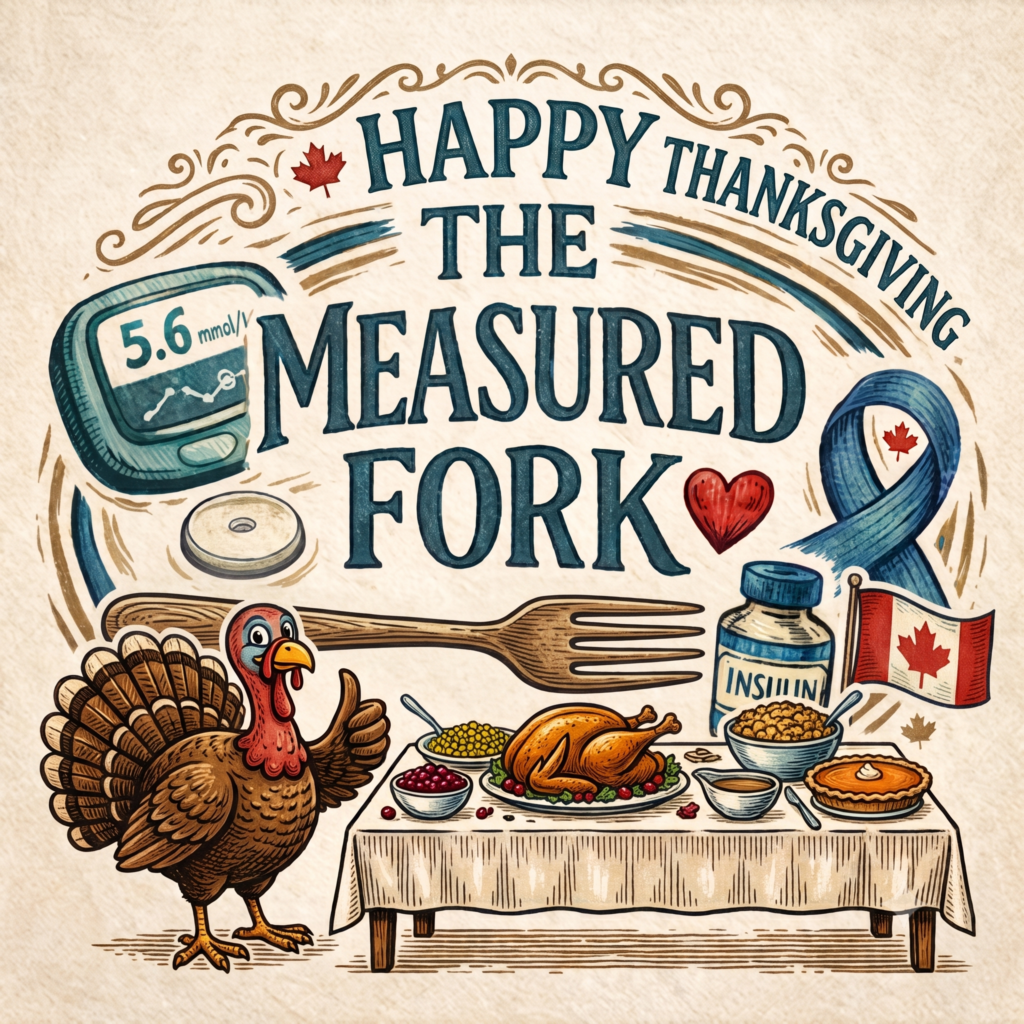
Happy Canadian Thanksgiving from The Measured Fork.
Living Well with Type 2 Diabetes, One Bite at a Time.