One Sunday night about a week ago I went to bed feeling a bit off. I was cold and achy — the kind of feeling where you suddenly put on socks even though you normally never sleep with them.
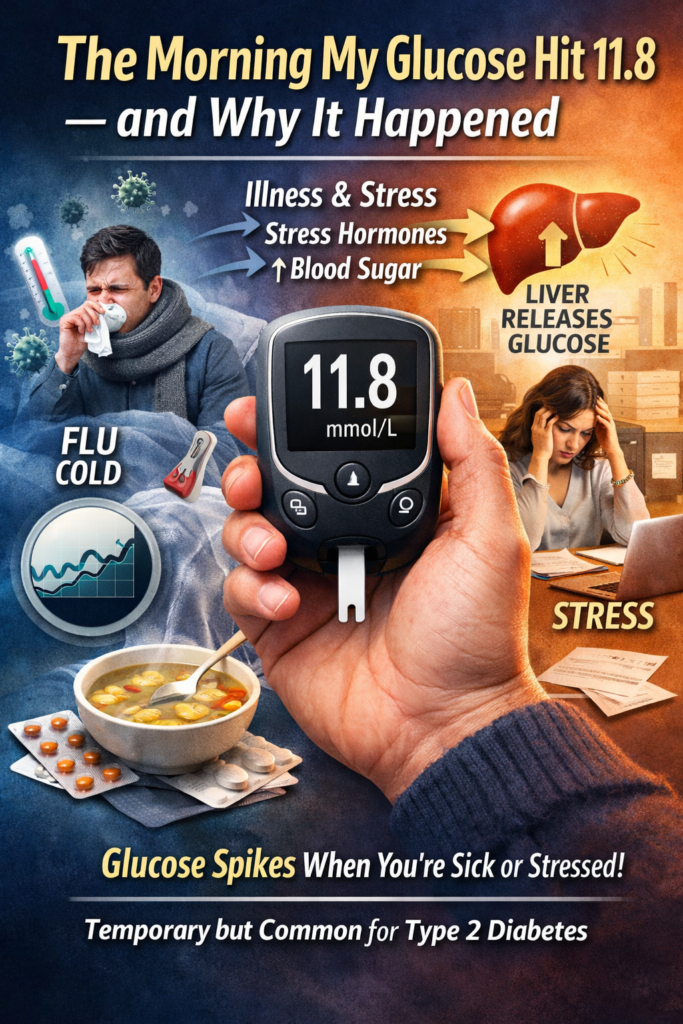
The next morning my Continuous Glucose Monitor showed 11.4 mmol/L. That immediately caught my attention.
To be sure, I checked with my Blood Glucose Meter and it read 11.8 mmol/L.
That was a wow moment for me.
Since being diagnosed with Type 2 Diabetes, my mornings are usually around 5.6 to 6.0, sometimes creeping up to 7.0, but never anything close to that.
I went to work anyway, thinking maybe I was just tired. Work had been a bit volatile in the days leading up to it, and I wondered if stress might have something to do with it.
After a couple of hours though, I realized I wasn’t feeling well at all. I told my manager and headed home. I took a cold tablet, had some chicken soup, and slept for quite a while. Later that evening I had some leftovers for dinner and took a couple of nighttime cold tablets before going to bed.
By the next morning I felt noticeably better — likely thanks to the rest and the medication.
But the experience left me wondering something.
Can stress or a flu-like illness push glucose numbers that high?
Diabetic Minute
Why can glucose spike when you’re sick?
What’s going on?
When your body is fighting an illness — even something mild like a cold or the flu — it releases stress hormones. These hormones signal your liver to release extra glucose into your bloodstream so your body has the energy it needs to fight the infection.
For people living with Type 2 Diabetes, this can sometimes cause glucose levels to rise higher than usual.
Why?
Illness and stress both trigger hormones like cortisol and adrenaline. These hormones can temporarily make the body more resistant to insulin while also increasing the amount of glucose circulating in the bloodstream.
This combination can lead to higher readings on a Continuous Glucose Monitor or a Blood Glucose Meter — even if your eating habits haven’t changed.
The catch?
It can feel confusing because the spike isn’t always connected to food. Sometimes it’s simply your body reacting to illness or stress while trying to protect and heal itself.
Takeaway
Yes — stress, colds, and flu-like illnesses can temporarily raise glucose levels. As your body recovers and those stress hormones settle down, your numbers will usually return to their normal pattern.
Tag line
Sometimes a higher number simply means your body is busy fighting something else.