What Is It?
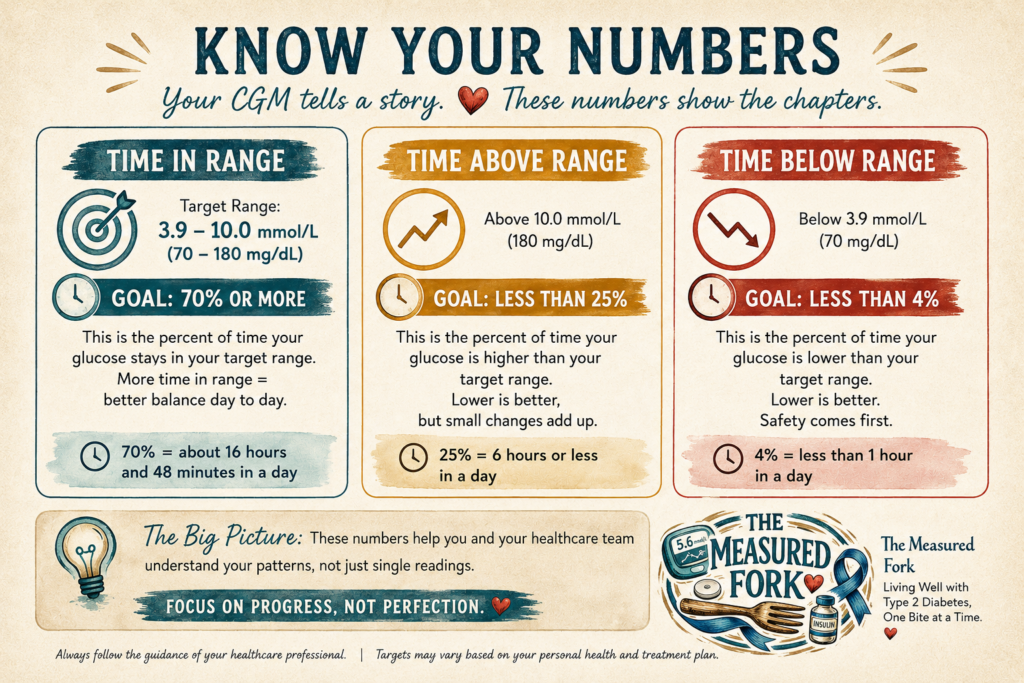
Time in Range (TIR) is a way of looking at how much of your day your blood glucose stays within a target range.
For many adults with diabetes who use a continuous glucose monitor (CGM), the commonly used target range is:
3.9–10.0 mmol/L (70–180 mg/dL)
Instead of focusing on one glucose number, Time in Range gives you a bigger picture of what your glucose is doing throughout the day.
Think of it as a snapshot of your day — but in motion.
Why Does It Matter?
Your blood glucose isn’t a single number. It moves up and down throughout the day depending on food, activity, stress, sleep, medications, illness, and plenty of other factors.
Time in Range helps show how often you’re in your target range, rather than focusing only on individual highs and lows.
For many people with diabetes, a commonly used goal is 70% or more of the time in range.
That’s about 16 hours and 48 minutes out of a 24-hour day.
The Catch
Time in Range is not the same thing as your A1c.
A1c gives you an estimate of your average blood glucose over roughly the previous 2–3 months.
Time in Range tells you where your glucose is spending its time.
Two people could have a similar A1c but very different glucose patterns.
And remember: 70% is a guideline, not a grade. Your individual target may be different depending on your circumstances and treatment plan.
The Takeaway
Time in Range isn’t about chasing a perfect number. It’s about seeing the bigger picture.
If you’re using a CGM, TIR can help you and your healthcare team understand your glucose patterns and identify where there may be opportunities to make adjustments.
Because sometimes, the story isn’t in one glucose reading — it’s in the pattern.
Measured Moment
One number tells you where you are.
Time in Range helps show you where you’ve been.