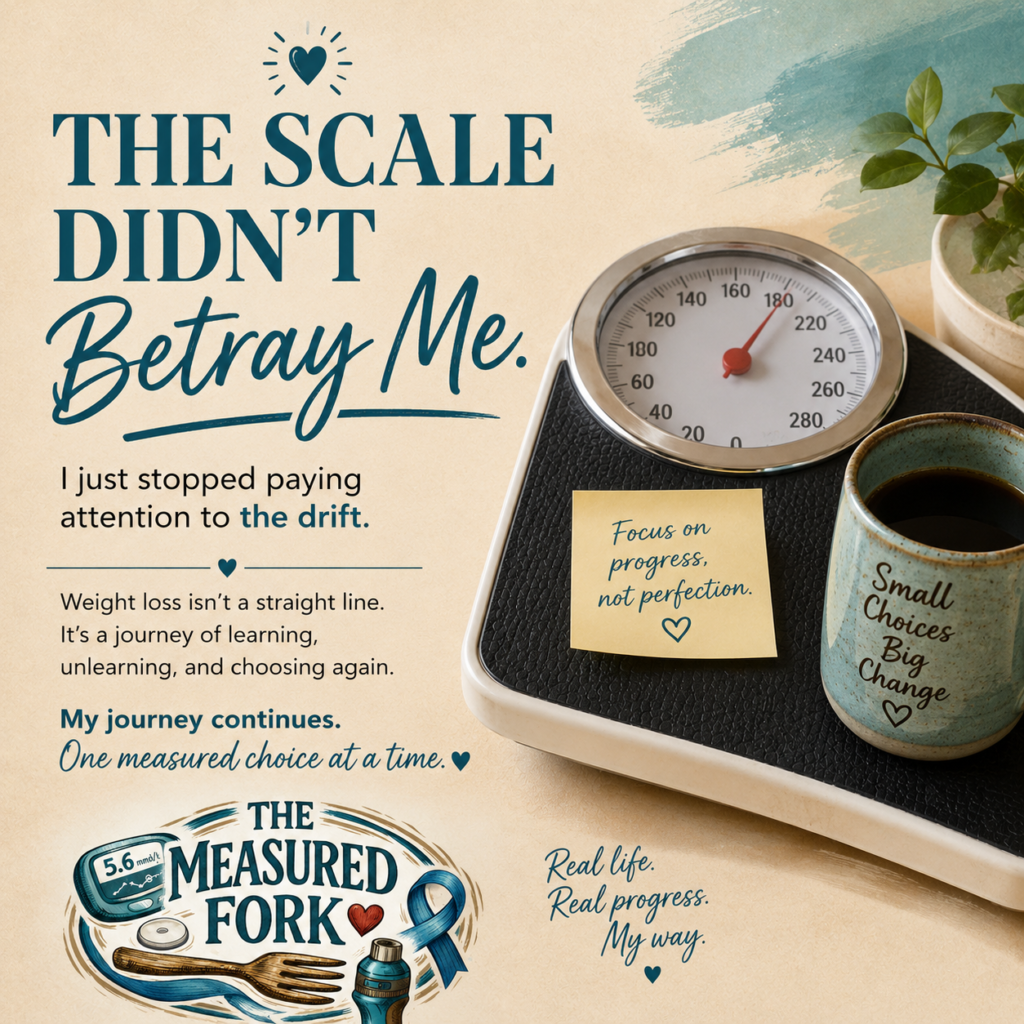
There was a time when I thought losing weight was the hard part.
Looking back now, I realize I had it backwards.
The hard part wasn’t necessarily losing the weight. The hard part was figuring out how to live at that lower weight once I got there.
When I was diagnosed with Type 2 diabetes in January 2023, I was somewhere around 210–220 pounds. Like many people, a diabetes diagnosis became a bit of a wake-up call. I knew I needed to make some changes, and one of the biggest was my weight.
So I started a structured weight-loss program with Nutrisystem.
And it worked.
I lost a significant amount of weight. By around 2024, I had reached somewhere in the neighbourhood of 155–160 pounds.
I remember thinking, I’ve done it.
And in a way, I had.
But that wasn’t the end of the story.
Then the Scale Started Creeping Up
It didn’t happen overnight.
There wasn’t one particular day when everything suddenly went off the rails.
Instead, the weight slowly started creeping back.
A pound here.
A few pounds there.
Life got busy. Routines changed. Food choices changed. Activity changed. Some of the structure that had helped me lose the weight wasn’t quite as present anymore.
And before I really appreciated what was happening, the number on the scale had moved considerably.
Today, I find myself hovering around 189–190 pounds.
That’s a long way from the 155–160 range I reached in 2024.
And naturally, that can lead to the question:
What happened?
Did I fail?
Was the weight-loss program a failure?
Did I suddenly lose all my willpower?
I don’t think any of those answers tell the whole story.
Losing Weight and Keeping It Off Are Two Different Things
This is something I don’t think we talk about enough.
We spend an enormous amount of time talking about how to lose weight.
Eat differently.
Reduce calories.
Increase activity.
Follow a program.
Set a goal.
Watch the scale.
And those things can absolutely help.
But what happens when you reach the goal?
That’s where things get complicated.
The habits that helped you lose weight have to become the habits that help you maintain that weight.
And maintenance can be surprisingly difficult.
Your body isn’t necessarily operating under the same conditions it was when you started.
As you lose weight, your body generally requires less energy to maintain itself. Your appetite and hunger signals can change. Your daily movement may change. And the amount of food that once created a calorie deficit may eventually become enough to maintain your new weight — or even slowly push it upward.
In other words, your body doesn’t necessarily say:
“Congratulations! You’ve reached your goal weight. Everything will stay exactly the same from here.”
Wouldn’t that be convenient?
Unfortunately, our bodies didn’t get the memo.
The Sneaky Nature of Weight Regain
One of the biggest lessons I’ve learned is that weight regain doesn’t always look like failure.
Sometimes it looks like normal life.
A restaurant meal.
A vacation.
A few more snacks.
A little less walking.
A stressful week.
Poor sleep.
A change in routine.
A few extra portions.
None of those things individually seems particularly important.
But when those little changes become the new normal, they can add up.
And because the change is gradual, it’s easy to miss.
That’s what makes creeping weight gain so sneaky.
You don’t necessarily wake up one morning and discover that you’ve gained 30 pounds.
You just slowly drift away from the habits that got you where you wanted to be.
It’s Not Just About Calories
Weight loss is often reduced to a very simple equation:
Eat less. Move more. Lose weight.
There is truth in the basic concept of energy balance, but real life is much more complicated.
Sleep can affect hunger and food choices.
Stress can influence eating habits.
Activity levels change.
Age changes.
Medications can play a role.
Hormones and appetite regulation can change.
And for those of us living with Type 2 diabetes, glucose regulation and insulin resistance add another layer to the conversation.
That doesn’t mean weight loss is impossible.
It means we shouldn’t assume that everyone’s body responds exactly the same way to the same approach.
So… Why Does Weight Loss Stall?
Sometimes the scale stops moving because the calorie deficit that existed at the beginning of a weight-loss journey has become smaller as the body changes.
Sometimes portions gradually increase.
Sometimes activity decreases without us really noticing.
Sometimes we’re retaining more water.
Sometimes our bodies are adapting.
Sometimes we’re simply eating enough to maintain our current weight.
And sometimes the scale isn’t telling the whole story at all.
That’s why a plateau isn’t necessarily a sign that something has gone wrong.
It can simply be a signal to pause and ask:
What’s changed?
Not:
What’s wrong with me?
That’s an important distinction.
My Biggest Lesson
Looking back at my own journey, I don’t think the weight I lost was wasted.
Far from it.
Going from roughly 210–220 pounds to 155–160 pounds taught me that I could make significant changes.
It taught me that my choices mattered.
It taught me that food could play an important role in managing my Type 2 diabetes.
And it taught me something else that perhaps took me a little longer to understand:
Getting there isn’t the same as staying there.
Today, at around 189–190 pounds, I’m not looking at my past weight-loss journey as a failure.
I’m looking at it as another chapter.
Maybe this time the goal isn’t simply to find another diet.
Maybe it’s to figure out what I can realistically maintain for the long haul.
Because life isn’t a six-month weight-loss program.
It’s everything that comes after it, too.
The Measured Fork Takeaway
I’ve come to believe that weight loss isn’t really a finish line.
It’s more like learning how to navigate.
Sometimes you take the right road.
Sometimes you take a detour.
Sometimes you realize you’ve been heading in the wrong direction for a while.
And sometimes you look at the map and say:
“Okay… apparently I took a much longer route than I planned.”
That’s life.
The important thing is that you can always reassess where you are and decide where you want to go next.
My journey from roughly 220 pounds to 160 and eventually back toward 190 isn’t a story about failure.
It’s a story about learning.
And maybe that’s the part of weight loss we don’t talk about enough.
The goal isn’t simply to lose the weight.
The goal is to build a way of living that you can actually keep.
A Gentle Note
Weight management is influenced by many factors, including nutrition, activity, sleep, medications, health conditions and individual biology. If you’re experiencing unexplained weight changes or having difficulty managing your weight or blood glucose, it’s worth talking with your healthcare professional. What works for one person isn’t necessarily the right approach for another.